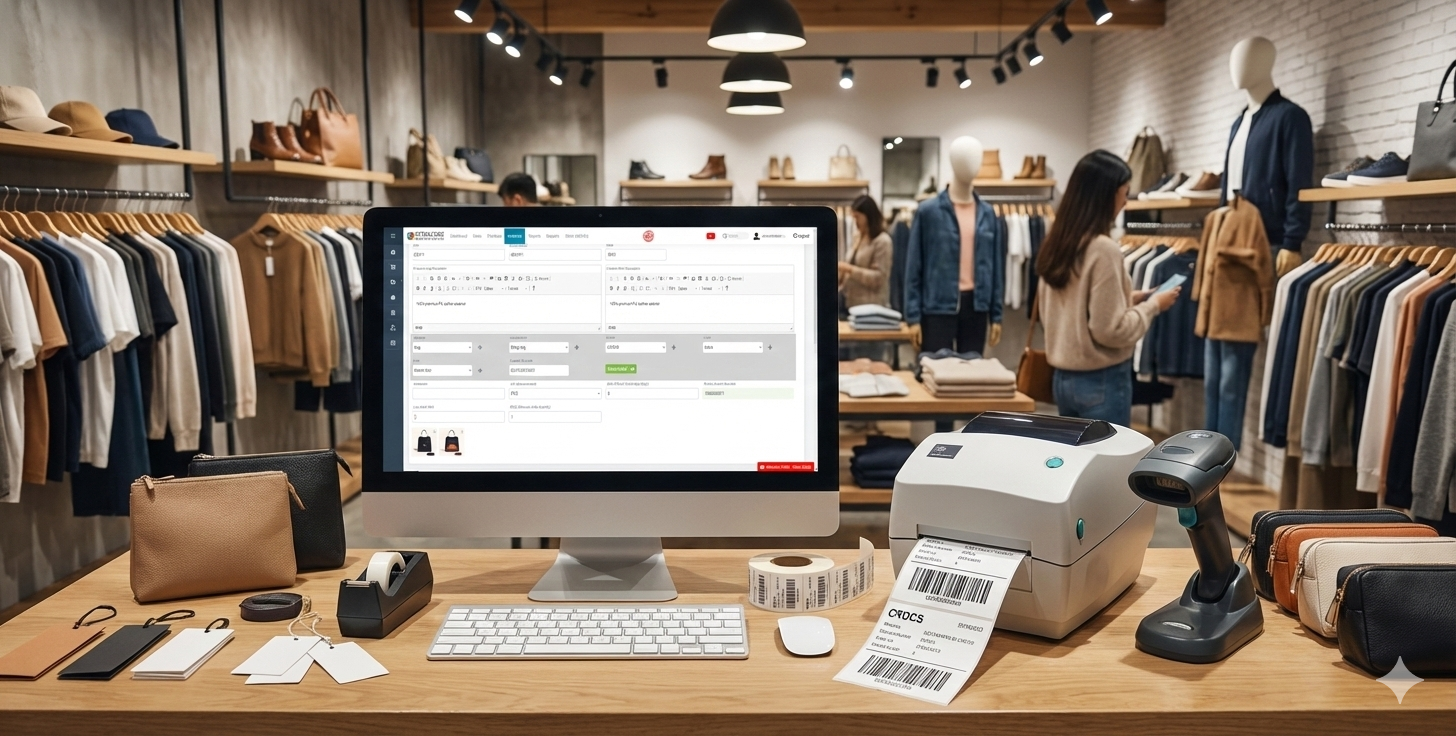
In an Indian fashion store, a “T-Shirt” is never just a T-shirt. It is a matrix of Small, Medium, Large, and Extra-Large, across five different colors. If you also sell accessories—like leather belts with different waist sizes, handbags in various finishes, or perfumes with specific batch numbers—your inventory complexity doesn’t just grow; it multiplies.
Managing thousands of SKUs manually or with basic software leads to “Phantom Stock” (where your system says you have it, but the shelf is empty). Here is how RetailCore helps you master this complexity without losing your mind.
1. Master the Matrix: Apparel & Beyond
For clothing, you need a system that understands Single-Dimension and Multi-Dimension Matrices. * The Apparel Matrix: One “Style ID” linked to 20 variations (Red-Large, Blue-Small, etc.).
The Accessory Matrix: For belts, the matrix might be Waist Size and Buckle Style. For wallets, it might be Material (Leather/Canvas) and Compartment Type.
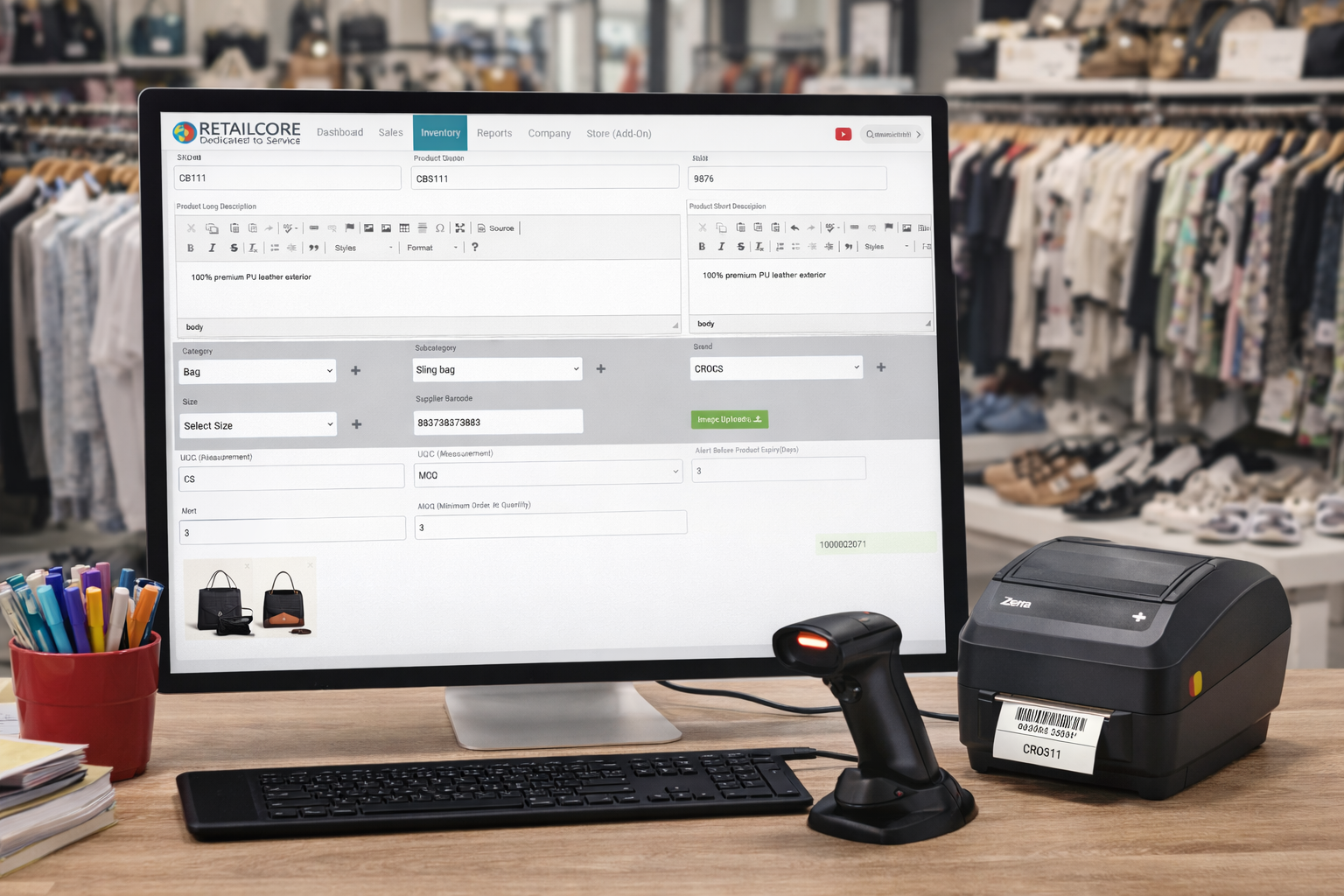
The RetailCore Advantage: You don’t have to create 50 separate products. You create one product and “generate variants,” which automatically creates unique barcodes for every single combination.
2. Professional Barcode Labeling for High-Value Accessories
Accessories like bags, perfumes, and wallets often come with manufacturer barcodes that are hard to scan or absent entirely for boutique items.
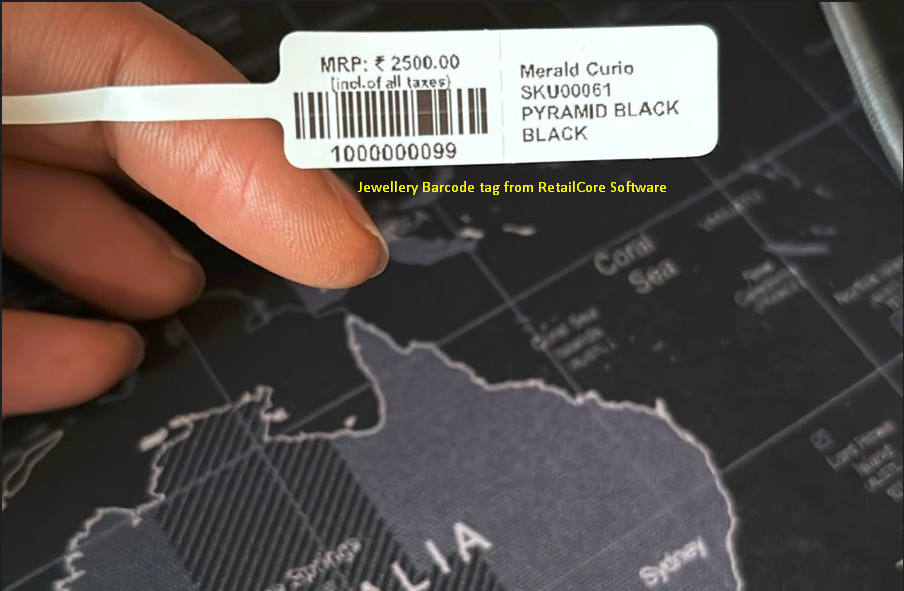
Custom Labels: RetailCore’s Barcode Label Design & Print feature allows you to print “Jewelry Tags” for small items like wallets or elegant labels for high-end perfume bottles.
Security & Pricing: Barcodes prevent “price switching” by customers or staff, ensuring the ₹4,999 leather bag isn’t billed as the ₹1,999 canvas one.
3. High-Speed Billing: From Browsing to Bagging
Fashion customers are impulsive. A long billing queue is the easiest way to lose a sale.
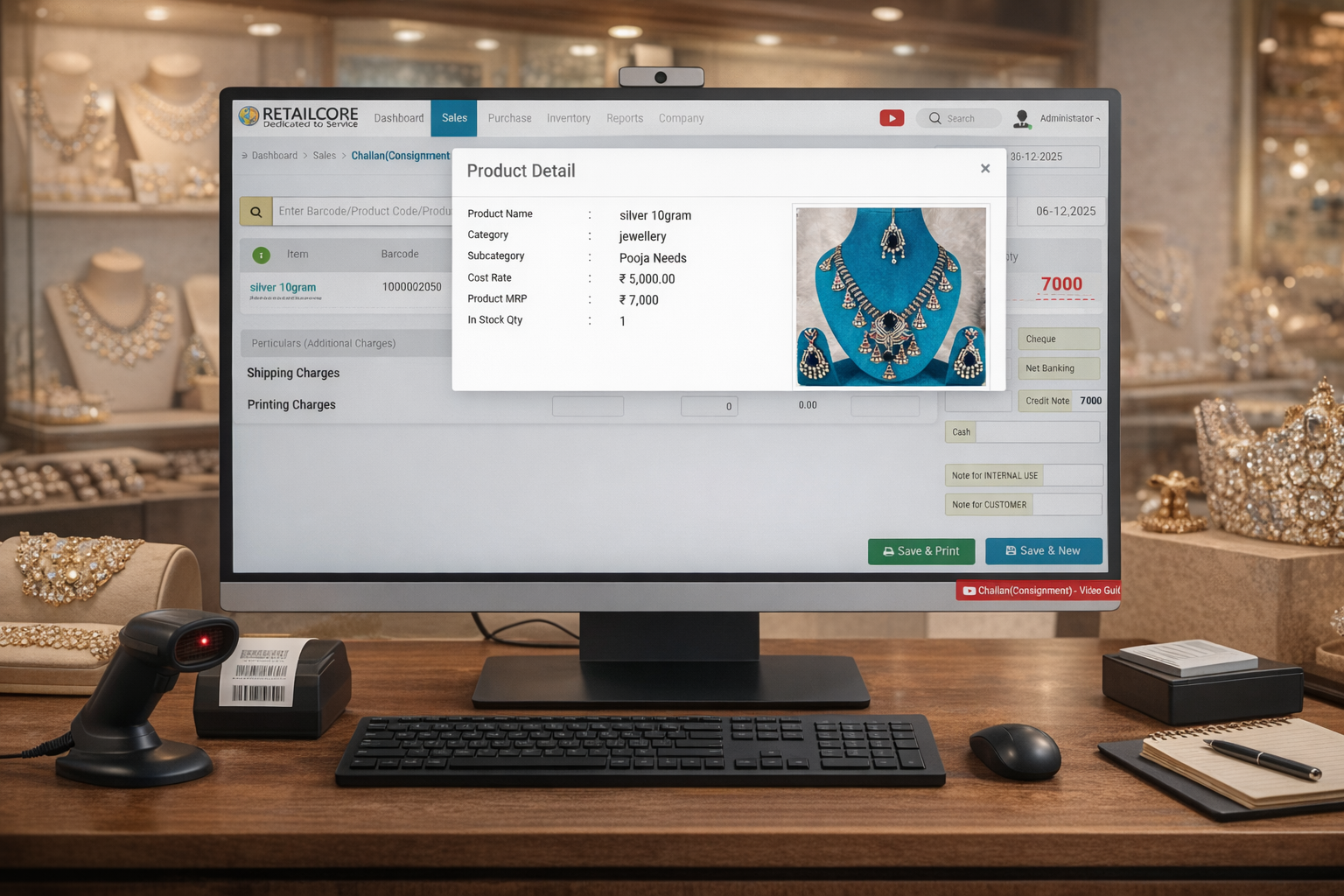
Fast Billing: With RetailCore’s POS, your staff simply scans the barcode, and the exact size/color variant is deducted from inventory.
Gift Bundling: If a customer buys a “Belt + Wallet + Perfume” combo, the system can handle “Kit/Bundle” pricing instantly, adjusting stock for all three items simultaneously.
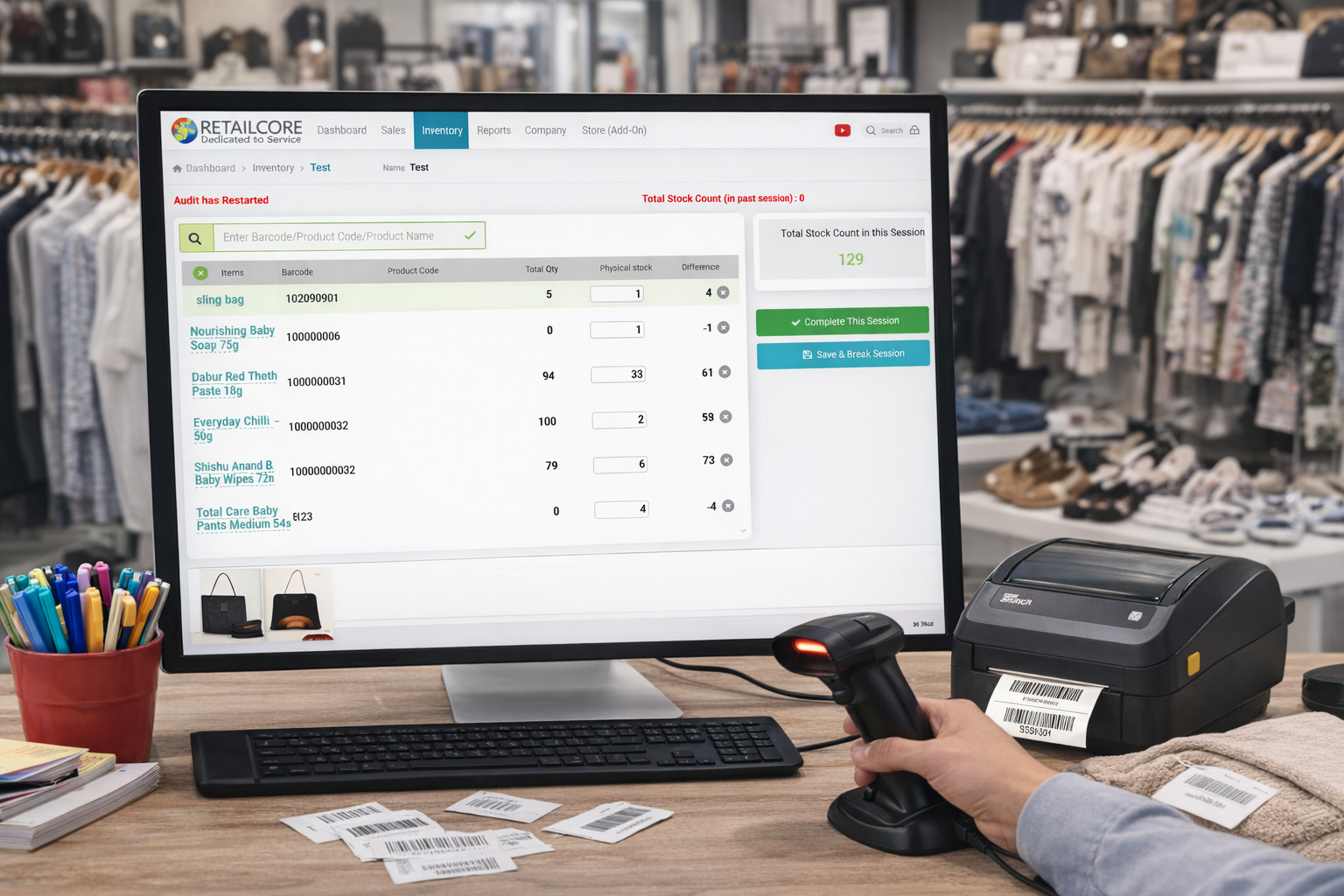
4. The “No-Stress” Physical Stock Audit
How do you know if a small item like a perfume bottle or a wallet has gone missing? Manual counting takes days and is prone to errors.
Scanning-Based Audit: Use a handheld scanner to “blind-scan” your shelves.
Category-Wise Audits: You don’t have to shut down the whole store. Audit the “Bags Category” on Monday and “Apparel” on Tuesday.
Discrepancy Reports: RetailCore instantly shows you the difference between “System Stock” and “Physical Stock,” helping you catch theft or shrinkage immediately.
5. Growing from One Store to a Brand (Multi-Store Management)
If your Mumbai store is sold out of “Blue-Medium” shirts but your Pune store has ten, you shouldn’t lose the sale.
Inter-Store Stock Transfer: View real-time inventory across all branches from your mobile.
Centralized Control: Change the price of a branded perfume at the Head Office, and it updates across all 5 stores instantly.
Data Security: Your customer database and sales figures are encrypted and backed up, ensuring your business “secrets” stay yours.
RetailCore Team Support – A Big Advantage
Technology alone is not enough. RetailCore is known for its hands-on support:
Complete software setup
Barcode label design & printing support
Staff training (multiple sessions if needed)
Prompt phone and remote support
Guidance during peak seasons
Many store owners say this support makes RetailCore different from generic POS software.
Frequently Asked Questions: Managing Fashion Retail Inventory
1. What is a “Size-Color-Style” Matrix in retail software?
The Size-Color-Style (SCS) Matrix is a system that allows retailers to group all variations of a single product under one “Parent” entry. Instead of creating 20 different products for one shirt design, you create one style and define its sizes (S, M, L, XL) and colors (Red, Blue, Black). This makes stock tracking and data entry significantly faster.
2. Can RetailCore handle accessories like belts and perfumes alongside apparel?
Yes. RetailCore is designed for “Lifestyle” retail. While apparel uses a size/color matrix, accessories use different attributes. For example:
-
Belts: Matrix based on waist size and buckle type.
-
Perfumes: Tracked by volume (50ml, 100ml) and fragrance notes.
-
Handbags: Tracked by material (Leather, Vegan) and color. All these can be managed within the same system seamlessly.
3. Do I need to create different barcodes for every size of the same shirt?
Absolutely. To have an accurate inventory, every unique combination (e.g., “Red-Large” and “Red-Small”) must have its own unique barcode. RetailCore’s barcode design and print feature automates this by generating unique identifiers for every variant the moment you inward your stock (GRN).
4. How does the software help during peak festive sale rushes?
During high-traffic periods like Diwali or wedding seasons, RetailCore’s Fast & Easy Billing (POS) ensures that scanning a barcode takes less than a second. Because the system is matrix-linked, it instantly updates the correct stock level, preventing you from over-selling or promising a size that isn’t actually in the warehouse.
5. Can I see my stock levels if I am not at the store?
Yes. RetailCore offers Multi-Store Management with cloud-sync capabilities. You can check real-time sales reports, stock levels of specific sizes, and staff performance from your mobile phone or laptop, no matter where you are.
6. How does a physical stock audit work with thousands of SKUs?
Instead of a manual pen-and-paper count which leads to errors, RetailCore allows for a Scanning-Based Audit. You simply scan the items on your shelf, and the software compares them to the “System Stock.” It will highlight exactly which variant is missing (e.g., “System says 5 Blue-XL shirts, but only 4 were scanned”), helping you identify theft or displacement immediately.
7. Is my customer and sales data secure?
Data security is a core feature of CoreSoftware. We provide role-based access control, meaning your billing staff can only see what they need to, while sensitive financial data and owner-level reports are protected and encrypted.
We are happy to support you.
Let us know about your requirement.
Click button below.